The Sessions
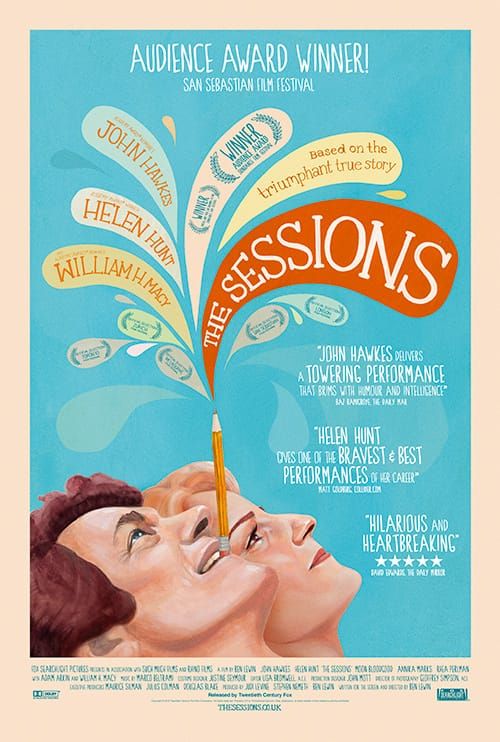
by Kryst Maddox-Lue
Watching this film sent me back to my days at university. More specifically the days of writing my dissertation (I should probably clarify that I did actually enjoy writing it, so this isn’t an unpleasant memory) the subject of which was the portrayal of disability in media. The reason it puts me in mind of this is simply because this film follows a disabled protagonist, the late journalist and poet Mark O’Brien.
What sets this film apart from others to which it might be likened, however, is the way in which the subject of disability is handled. Unlike other films about disability that I’ve studied, this film doesn’t focus entirely on Mark’s disability (paralysis from the neck down and 16-hours a day bound to an iron lung, as a result of contracting polio) but more on Mark’s struggle to validate his life and manhood, certainly this was as a result of his disability, but that fact seems almost detached from the plotline.
I suppose, the best way to describe what I mean is by likening the plot to LOST IN TRANSLATION. That film does feature language barrier (English and Japanese) but the film isn’t simply about Bob and Charlotte being unable to find their hotel because they struggle to make themselves understood – it’s about something a whole lot deeper. The same goes here.
Moreover, Mark is portrayed as a man in full control of his life, and it’s direction, despite his physical problems. In fact, the beginning of the film shows him seeking advice from his church priest, Father Brendan, on whether, or not, it would be wrong to fire his current caretaker. Not because she’s incompetent, but because she ‘looks at [him] in the wrong way’, basically making him feel small and unimportant. It’s refreshing to see a character as severely impaired as Mark taking charge of his life, rather than letting doctors, carers, or an overbearing mother do so, as is often the case in films such as these.
At the same time, however, Mark retains a sense of weakness that is often an unfortunate part of being faced with challenges such as his. For example, when he falls in love with young and beautiful care worker, Amanda, he shows his emotional vulnerability by falling prey to a classic case of Florence Nightingale syndrome. Proving that, though emotionally stronger than most, like all men (and women) he’s not infallible. And again, near the film’s end, when there’s a power cut and his iron lung stops working, we are given insight to his physical susceptibility, and the negative repercussions of his choice to live alone, as he struggles to summon help.
Eventually he is discovered and rushed into hospital. This final excursion leads to him meeting a young doctor named Susan, whom Mark found love with, until his death in 1999.
Overall, I think this film is very well done. The cast are brilliant, as you’d expect from such an experienced group of actors as John Hawke, Helen Hunt and William H. Lacy, and the direction is average. Not that I think the film suffers for this, the story stands out, meaning that the direction doesn’t have to.
There are some really comedic bits that I absolutely adore, because, although I know that the actual subject of disability isn’t funny – life is! There are times, as a disabled person, where you want to laugh and cry in unison, and that’s what this film captures. Like the part, right at the beginning, where Mark wakes up in the dead of night, to find his cat entering through the window, as it does so, it’s tail whips his nose, making it itch: which of course, he can’t scratch. This makes you want to cry out in frustration for his character and, bizarrely, laugh at the sheer awkwardness of the situation that he’s in, which sets a great precedent for what’s to come.