Born This Way
by Bethany Lewis
The LGBT community in America has it hard. On a daily basis they face prejudice, abuse, misconceptions, unequal human rights and protection under the law, and sometimes threats and bodily harm. It’s a well-known and well documented controversy within the U.S., but the tides here are turning – a majority of the country now supports equal rights for LGBT persons, and the number of states which allow gay marriage is steadily growing. Not so in Cameroon. Americans, by and large, tend to know very little about the continent of Africa (except what popular viral videos shared on Facebook tell us), let alone the political struggles of specific countries within it. But in Cameroon, homosexuality is against the law – punished by up to five years in prison and a fine of ₣200,000 – and even the rumor of homosexuality is condemned by threats of death by angry mob. One cannot be an out gay in Cameroon, and one must be very careful about who one sees, where, and how often.
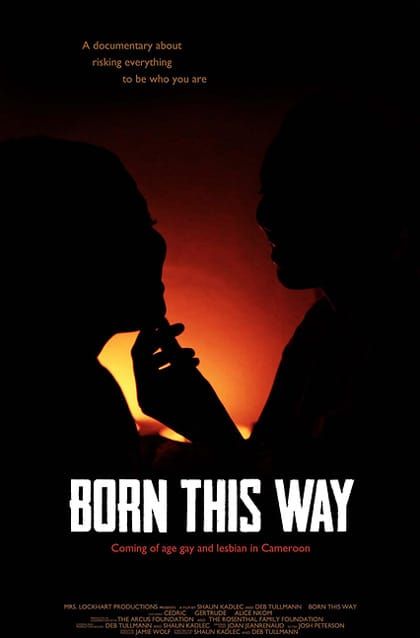
BORN THIS WAY is a documentary about the LGBT community in Cameroon and their daily struggle living in what is one of the most violently homophobic countries in the world. The film mainly follows two young Cameroonians – Gertrude and Cedric – as they go to work, meet with friends and lovers, visit with family, and talk about their experiences living as a homosexual in Cameroon. Both are charming, intelligent, and passionate people, and as we come to know them and see their pain and loneliness, the harder it is to countenance the injustice of the discrimination against them. As the documentary progresses, we learn more about Cameroon’s oppressive society, but also come to see the many natural and cultural beauties of the country. Both Gertrude and Cedric talk about how one would have to leave Cameroon to live as an openly gay individual, but how both love their country, how they don’t want to leave it, and would rather stay and fight for freedom and acceptance.
And it is relieving to see that they’re not alone in the fight, despite the open hostility much of the population directs towards them. Both Gertrude and Cedric work at a Cameroonian organization that officially gives help and education to treat and prevent HIV/AIDS, but also discreetly operates as a support center for the LGBT community. One of the things this documentary excels at conveying is the utter loneliness felt by LGBT individuals at being unable to share an important part of themselves with the people they love – as in Cedric’s case, who is so close to his mother and yet cannot fathom coming out to her for fear that her seemingly unconditional love and support will falter. The other extreme is also masterfully expressed, when Gertrude and Cedric work and play with people who love and support them for who they are – as in Gertrude’s case, when she finally comes out to the mother figure who loved and supported her as she grew up, and who continues to love and support her regardless. The absolute joy they take in each other and in being able to fully be themselves with others is palpable and contagious. One cannot imagine why that joy should be oppressed or hated.
As unfortunate as the circumstances are, BORN THIS WAY’s tour of the festival circuit is extremely timely. A mere two weeks ago an LGBT activist journalist named Eric Lembembe was found tortured and killed in his apartment in Yaounde, Cameroon. The authorities, knowing Lembembe’s associations and the probable motive behind his murder, have predictably done very little to find his killers other than arrest two of his co-workers from CAMAIDS, the LGBT human right organization. One of those co-workers is named Cedric. While he and his other co-worker were eventually released from custody, they were held for three days without being charged, contrary to Cameroon’s criminal procedure code which allows for suspects to be held up to 48 hours without being charged. This documentary, combined with Lembembe’s death, is bound to cause ripples too big to ignore. And not just in Cameroon. Anyone, from any country, who is interested in, unsure about, or even against LGBT rights should watch this documentary. Watching and getting to know Gertrude and Cedric, the kind of people they are, their extraordinary strength and determination, and their complete and utter normalcy aside from the small matter of the way in which they happen to make love, would make anyone realize that these are individuals not so different from ourselves. And that’s enough to make anyone wonder why someone so similar to ourselves should be hated for what they are – that anyone is just a caprice of society away from being in the same senselessly vilified boat.