Beasts of the Southern Wild
by Krystie Maddox-Lue
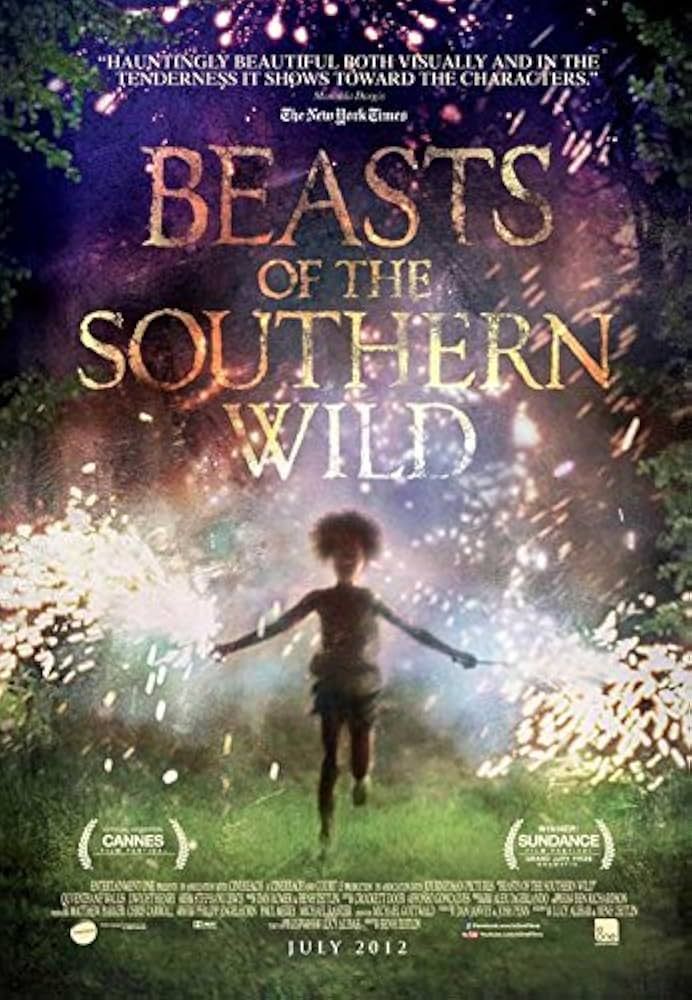
Benh Zeitlin's feature length debut is a fantasy, drama, set in the fictional Bayou Territory referred to, by the locals, as "the bathtub" (a location most probably based on the real "Isle De Jean Charles"). The story takes place around the time of the hurricane Katrina catastrophe and documents the life of six year old Hushpuppy, superbly portrayed by Quvenzhané Wallis, who lives in the poverty-ridden bathtub, with her dying father (Wink), and a community of loving, yet almost feral, neighbours.
Feral's a word I use for want of a better term; the people aren’t monsters, or animals, they’re shown to care about, and look out for one another regardless, or in spite of, gender and race. A necessary move for survival perhaps, or else tribal instinct. Yet the poverty is shown to be such that it’s a case of eat, or be eaten – a feral state of being. This is further implied by the impression of schooling shown, whereby the ‘teacher’ gives a surprisingly modern lesson based around ideas of tribal pack-survival, the balance of the universe (or how we’re all part of “the buffet of the universe”) and the sea levels rising, due to the melting of the polar ice caps.
I say ‘surprisingly’, only because the Southern part of America (particularly the bible belt, where the film’s set) is often portrayed as so religiously fundamental that the characters appear socially backward. Refreshingly, that isn’t the case here, neither are any of the other ‘hallmark trades’ that have come so cruelly to be associated with the deep south, dropped rather crassly into the story.
In a sense the film seems to be almost post-apocalyptic, with the characters that are introduced, existing as the last remnants of human society. In fact the only reason we realise this isn’t the case is because Hushpuppy and Wink sit in a self-made motorboat looking across at the levee, partially blocking from sight the chugging factories behind it. A sight that prompts Wink to state: “Ain’t that ugly over there? We got the prettiest place on earth.” Informing us that life outside of the bathtub exists.
The location of filming (Terrebonne Parish, Montegut) is, by and large, beautiful, displaying large areas of greenery, unsullied by man-made structures. The way with which the people interact with the area (living off the land, and in tune with nature: at one point Wink even reminds Hushpuppy to share her food with the animals so that they could all eat) makes it almost a character in itself. The wildness of the area is not damaged at all by the chaos of Katrina, but simply enhanced. Hushpuppy, and the other locals who didn’t flee before the storm hit, also seem unfazed by its fury, lamenting the fact only when it becomes difficult to find and grow/graze food, due to the high level of water.
Further, the only time the group appear uncomfortable with their surroundings, is when they’re taken away from the bathtub, and to a ‘rescue’ centre. Hushpuppy rather eloquently sums up this venture by comparing the centre to a “fish tank with no water”.
Personally, I find this part the most interesting to watch, I'm unsure as to why specifically, perhaps it's the way in which the film challenges modern conformity? Though, in many ways, the locals of the bathtub are no different from the mainlanders, they are behind on the times, in that they don't appear to use much electricity, or electronic items, neither do they appear to follow fashion trends, or anything that the rest of Western Civilisation values as important.
The rescue centre therefore tries to show its kindness by attempting to impose some of these values onto the bathtub refugee's, much to their dismay. This is captured brilliantly in one scene where Hushpuppy stands uncomfortably in the children's playroom with her hair scraped back into a ponytail and wearing a donated blue dress, staring at her father, who looks back helplessly as doctors mill around him, presumably treating his illness. (It is revealed that he has an undisclosed illness - probably leukaemia - which is causing his blood to "eat itself".)
The story to the film is very endearing, if at times a little confusing, it's missing that certain something that would make it amazing, however makes up for this a little by the standard of acting, which and, as I've said before, is superb. What I found most off putting however was the lighting, which I found to be unnecessarily dark at times, making the film slightly difficult to follow.