
The Telephone Game
“It’s not that bad. it’s not like he’s going to be rolling in his grave or anything. Plus, he’s cremated.”
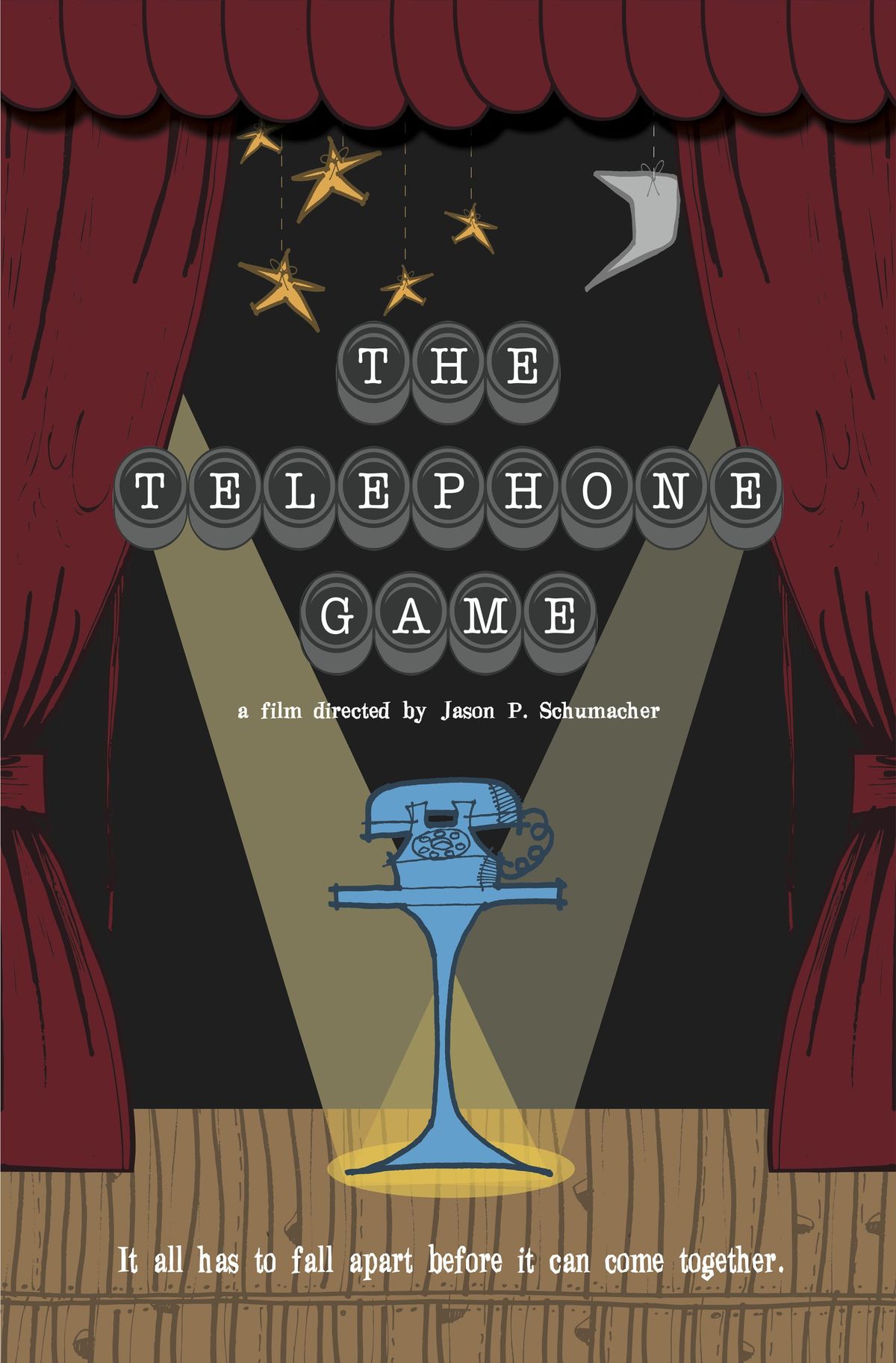
What happens when the artist is bigger than his art? Sounds like a recipe for disaster. But the outcome of that scenario is a rosier alternative to what Jason P. Schumacher unveils in his film, THE TELEPHONE GAME (2011), in which both artist and art were never really all that great to begin with …
Just don’t tell the artist that.
The artist in question, Marco DeGarr (Wes Tank) is a playwright and director who decides that he and he alone is fit to play the lead role in his self-proclaimed opus, “The Invisible Ropes.” That would be an obstacle in an of itself if the only issue were that Marco was not an actor.
Worse yet, however, is that Marco falls for his leading lady, Zelphia (Haley Chamberlain), while also falling off the firm ground of sanity as he strives for perfection and total control in a far-from-perfect play. And while he breaks from his own reality, his surreal play, and perhaps even his leading lady, are pulling away from his grip.
Can the artist still live without his art?
THE TELEPHONE GAME is a comedy, yet one without any true laugh-aloud moments. It’s not intended to be. It’s smarter than that, and, though outlandish, it hits a bit too close to home to be reduced to knee-slapping guffaws. Schumacher achieves his goal of revealing the absurd strains and dynamics of producing a play – regardless of whether that play debuts on Broadway or Main Street – with smart, quirky humor, reminiscent of The Coen Brothers’ FARGO.
Tank is the centerpiece of the film and takes the reigns with gusto. He’s a control freak who’s losing control, and its Tank’s facial acting, and movement within scenes that show his recoil from reality. In Act II (like a play the film is broken up into three acts) Marco returns from a brief hiatus to rehearsal in a disheveled state. But his erratic state of mind isn’t depicted by an untucked shirt, uncombed hair or an unshaved face. It is Tank’s movements as an actor, the pacing of the stage, the OCD-like straightening of his script notes, that prove that Marco is in no shape to be on stage.
Schumacher shot the film in black and white, which I find an ironic choice. Black and white is so often tied in with art-house films, so was Schumacher imitating art? Was he invoking Marco, declaring (mockingly) that his film was far more serious than others could ever understand?
The approach is brilliant. This feels like an art-house film that never becomes an art-house film, and thus the audience gets a better sense of Marco’s plight as a fledgling playwright with a fledgling play.