
The Days God Slept
by Bethany Lewis
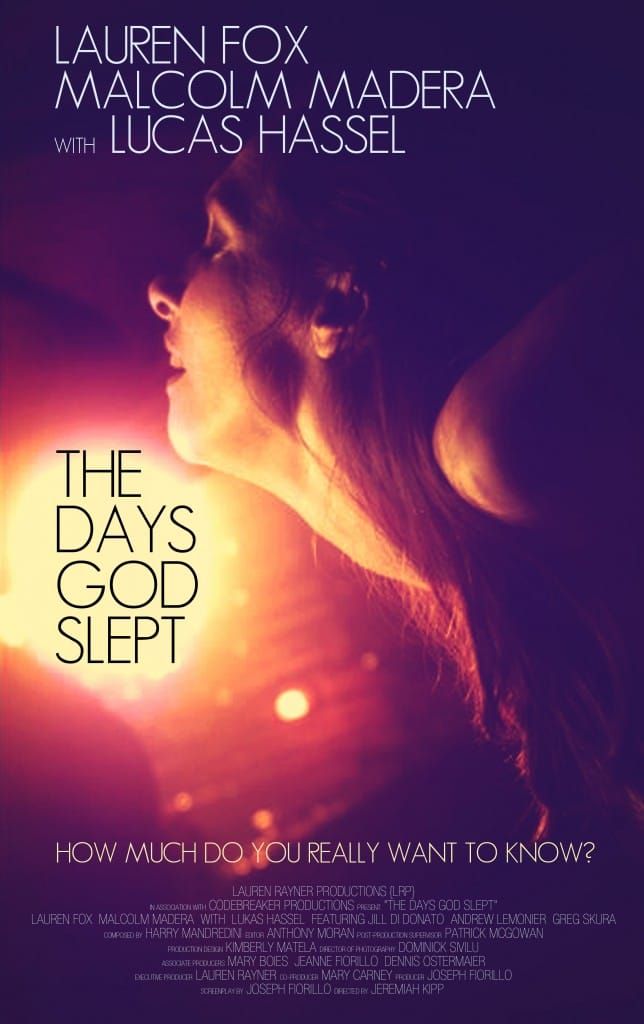
Jeremiah Kipp’s new short experimental film, THE DAYS GOD SLEPT, is as intense – both thematically and visually – as any of his previous works. And like much of his work, this new short also focuses on the relationship between a man and a woman, and some level of conflict between the two. In this case, the woman (Lauren Fox) meets up with a man (Malcolm Madera) to tell him a dark secret from her past. She tries to make it pretty, exciting, and exotic – romanticizing the gritty details to make the truth more palatable, less harsh. The man seems curious, understanding, and compassionate, but ultimately confused about how to react. Perhaps it is difficult to reconcile the person he knows with the choices she made in the past. In the end, it’s not about the man or his reaction. It’s about the woman, her choices, and her intention to be taken on her own terms, without holding back. It’s about her ability to reconcile her past with her present, and her faith with her actions. Given the religious context, it might not be much of a stretch to compare her sordid past and her confession to the redemption of Mary Magdalene. Lauren Fox certainly has an ethereal and pious look to her that reminds one of the Renaissance era religious portraits of Magdalene. While putting Malcolm Madera in the shoes of Jesus is going a bit too far into this religious metaphor, there is something stiff and clerical about his character that makes him compatible with the part of a priest.
It is nice to see that Kipp’s female protagonists continue to evolve into stronger, more rounded and complex characters. While there are undoubtedly some questionable interpretations to be made regarding this female character, at least she doesn’t end up lying naked in the fetal position. She takes charge of a delicate situation, reveals her past without apology, owns up to her own decisions, and ultimately stands by them. Whatever the male character’s reaction to all this, it isn’t her who is left in the dust and rejected by patriarchal social conventions. It is the man who is left alone at the end to rethink his perception of feminism and femininity. She challenges conventions and expectations, makes us reconsider what should and shouldn’t be acceptable female behavior. At the same time, she appears to be ashamed of her past actions, which at first glance might seem incompatible with the strength of her honesty. But as she says at the beginning of the film, “things are both precisely and not at all as they appear.”
Lauren Fox (her character unnamed in the film but credited as Kristy) perfectly suits the strange mixture of vulnerability and strength that her character embodies. She looks delicate and ethereal, like a woman from another, simpler time – a time of faith and nature. She looks oddly out of place in the environs of a strip club, giving lap dances, having group sex – which is what makes those scenes and her past all the more striking. There are so many facets to her character merely glimpsed at in such a short time and Fox somehow seems to both fit them all perfectly and yet fit none at all. We can’t quite put our finger on what it is about her that draws us to her or what keeps us from knowing her. Malcolm Madera plays the man in the film, and while he is a strong and unique presence, his character is more or less anonymous. He gives off a casual genuineness that makes him refreshing to watch, and a neutrality that makes his symbolic role as confessor a perfect match.
True to form, Kipp’s films are visually compelling, thematically complex and often polarizing, well shot, and intriguingly edited. They are films that invite the audience to make its own interpretations, leaving them thinking, discussing, and theorizing. They are anything but simple, and THE DAYS GOD SLEPT is no exception.