Subprime
by Aaron Weiss
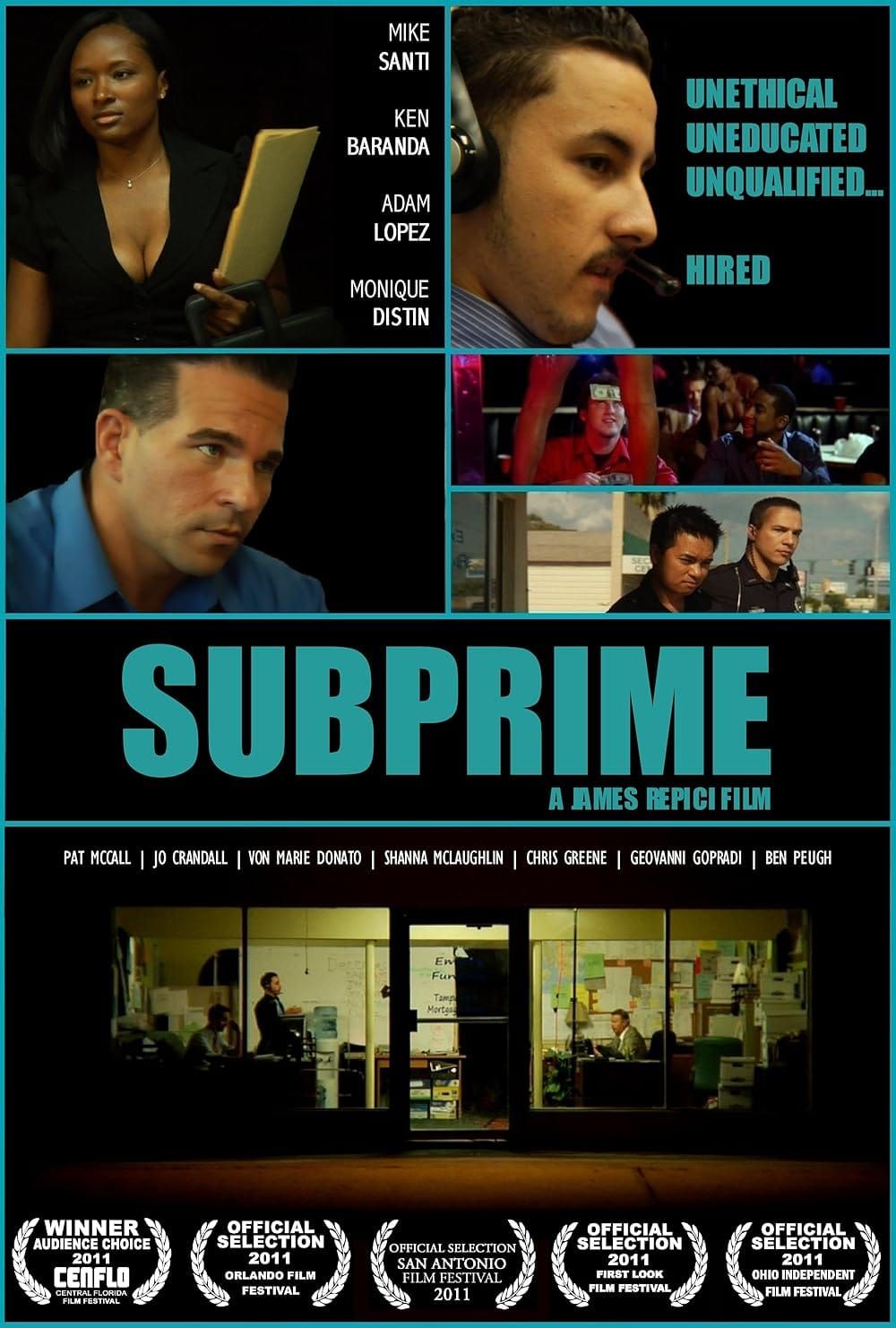
The global financial crises were comprised of multi-faceted domino reactions that reached from top to bottom of the financial food chain. SUBPRIME exposes just a mere block in a large chain reaction: how subprime mortgage companies preyed on not only unsuspecting consumers, but also desperate employees who would become their pawns.
Mortgage brokerage company owner Michael Banco (Mike Santi) begins to coach his new hire David (Ken Baranda) to land highly profitable and predatory subprime mortgages that desperate homeowners need to maintain their home or purchase a new one. David develops different fraudulent techniques to sign new mortgages while assimilating into new lifestyle of infidelity and drug use that continuously feed the fraudulent activities. David, along with his co-workers, is constantly hounded to make barely reachable quotas to maintain their jobs, provoking them to make shadier deals.
SUBPRIME is hindered by the unfocused voice-over narration by the gruffly voiced Nick (Patrick A. McCall), the oldest worker in the company. As the synopsis explains, the main narrative follows David’s rise and fall through predatory subprime mortgages and the greed-fed desperation that is so closely linked with the lifestyle. Nick’s inclusion into the film is almost unnecessary as since the David’s perspective is rather clear.
The settings in the film match the predatory sleaze and lifestyle of the occupation. The fluorescent lighting aptly exposes the tight confines of the mortgage office; however, the rest of the film’s scenes have an amateurish and irritating interior lighting. While I enjoyed SUBPRIME’s setting of Tampa, FL, my current residence, the film overuses exterior shots of the skyline and buildings as master shots and transitions. The actors are indeed passionate about their roles, but a majority of them do not offer any distinguishable performances, and a few characters could be combined into one.
The film begins with a few rather intriguing scores, particularly the opening credits. There is a classic Hollywood cinema tone to it that sets the atmosphere and mood, yet the rest of the music used in the film seems contrived and forced. One of the more questionable choices in the film is the 4:3 frame formatting that seems to be antiquated when compared to the subject at large. Lastly, the film has several one-take, static shots that have hints of Italian neo-realism, but the moments are insincere and really could have used the additional real estate the 16:9 format offers.
SUBPRIME fills a void about a subject that many tend to ignore because it either hits too close to home or they have no direct connections. The past few years, there have been a slew of films that have presented the financial meltdown in order to deliver an easier to digest understanding of what went wrong. Films such as TOO BIG TO FAIL, INSIDE JOB, and MARGIN CALL have portrayed the political and financial issues that would lead to the Great Depression, however SUBPRIME takes to down to ground level in a sphere where it targets the unsuspecting 99% who are hit the hardest. Yet, the film also has a feeling that is reminiscent of the urgency and crooked pedaling found in Glengarry Glen Ross.
Despite the stark criticism, SUBPRIME has a narrative that properly depicts the rise and fall of a subprime lender and certainly does have substance worthy of attention. The issue with films about serious and topical subjects like these is that they attempt to reach those ignorant of the issues, but they are ultimately seen by the choir, those who already know the devastating effects of predatory subprime mortgages had on American consumers’ dreams.