Stoker
by Bethany Lewis
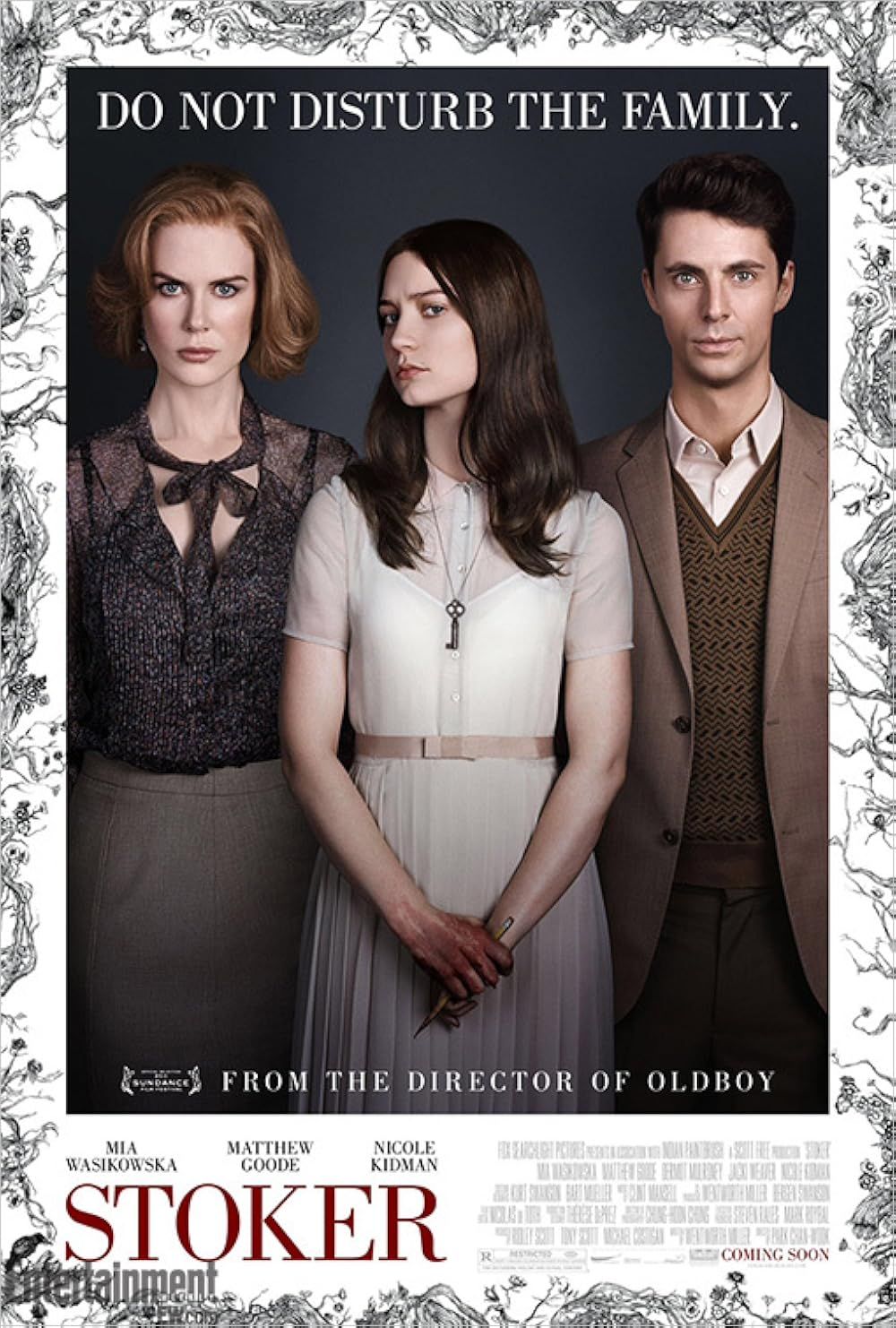
STOKER, the English language debut of Korean director Chan-wook Park, is very basically a coming-of-age story gone terribly wrong. Of course, with issues of nature and nurture, sexuality, revenge, and the dynamics of familial relationships, this coming-of-age story is anything but basic. The Stoker of the title refers not only to the sullen and morbid young India Stoker (Mia Wasikowska) or even to her sinister and charming Uncle Charlie (Matthew Goode), but to the entire Stoker family – a family with a sordid and tragic past that quickly turns twisted; a family that entirely lives up to the gothic horror connotations their name evokes, with added shades of David Mamet’s HOW I LEARNED TO DRIVE.
The gothic horror begins when India’s father is suddenly killed in a suspicious car accident and her Uncle Charlie appears at the funeral and comes to stay with India and her self-involved mother Evelyn (Nicole Kidman). While it isn’t immediately clear what the smooth talking and cultured Charlie wants or why his existence was hidden from the family, it is instantly obvious – despite India’s initial hesitance – that he and India share a connection. There is a gleam in Charlie’s unnaturally wide and blue-eyed stare that eerily mirrors the stars in India’s own wide blue eyes. There is only a hint at first of this connection, but as Charlie guides India into adulthood, corrupting her with a first illicit taste of wine, the stars in her eyes brighten to match the intensity of Charlie’s as they stare across the table at each other.
And while their relationship is a natural focus of the film, the heart of the story is India’s sexual awakening and journey into adulthood, however roundabout or unnatural that journey may seem. Mia Wasikowska’s India starts out with an overactive internal life, her gaze ever turned inward. Once Charlie arrives on the scene, she walks through life-defining moments with a look of wonderment and fear in her eyes, as if she were witnessing her own experiences from outside herself with the audience at the same time as living out those experiences. Matthew Goode’s Charlie has a more knowing look about him, but something of the same ultra-engaged yet somehow detached stare. He manages to remind one of a more worldly Norman Bates. And just when you think you have him figured out, he does something to prove you wrong, only to throw those expectations back at you again.
STOKER itself is a beautiful and unique piece of filmmaking that clearly bears its director’s mark. As with many of his previous films, Park has a tendency to indulge in detailed and lingering shots of objects, facial features, or bodily wounds. His measured, yet arrhythmic pacing, unusual transitions, selective framing, and the subdued quality of his actor’s performances combine to create an artistic minimalism that contributes to the disturbing matter-of-factness in which extreme events are presented. Park’s films also tend to represent a certain amount of his unique characters’ inner lives through the use of stylized film techniques, as with the sound design for India and Charlie’s acute sense of hearing. Similarly, in the first part of Park’s acclaimed revenge trilogy, SYMPATHY FOR MR. VENGEANCE (2002), the reverse ability is portrayed when the diegetic sound is replaced by a watery white noise to represent the subjective experience of a deaf and dumb character. The thematic issues at hand (sexuality, incest, murder, sadism) are very near and dear to Park’s heart and are explored with very little hesitance considering his English-speaking audience. While the exploration of these issues may be a little too frank for the average American moral sensibilities, that is by no means a drawback of the film. It is dark, twisted, uncomfortable, shocking, beautiful, and funny.