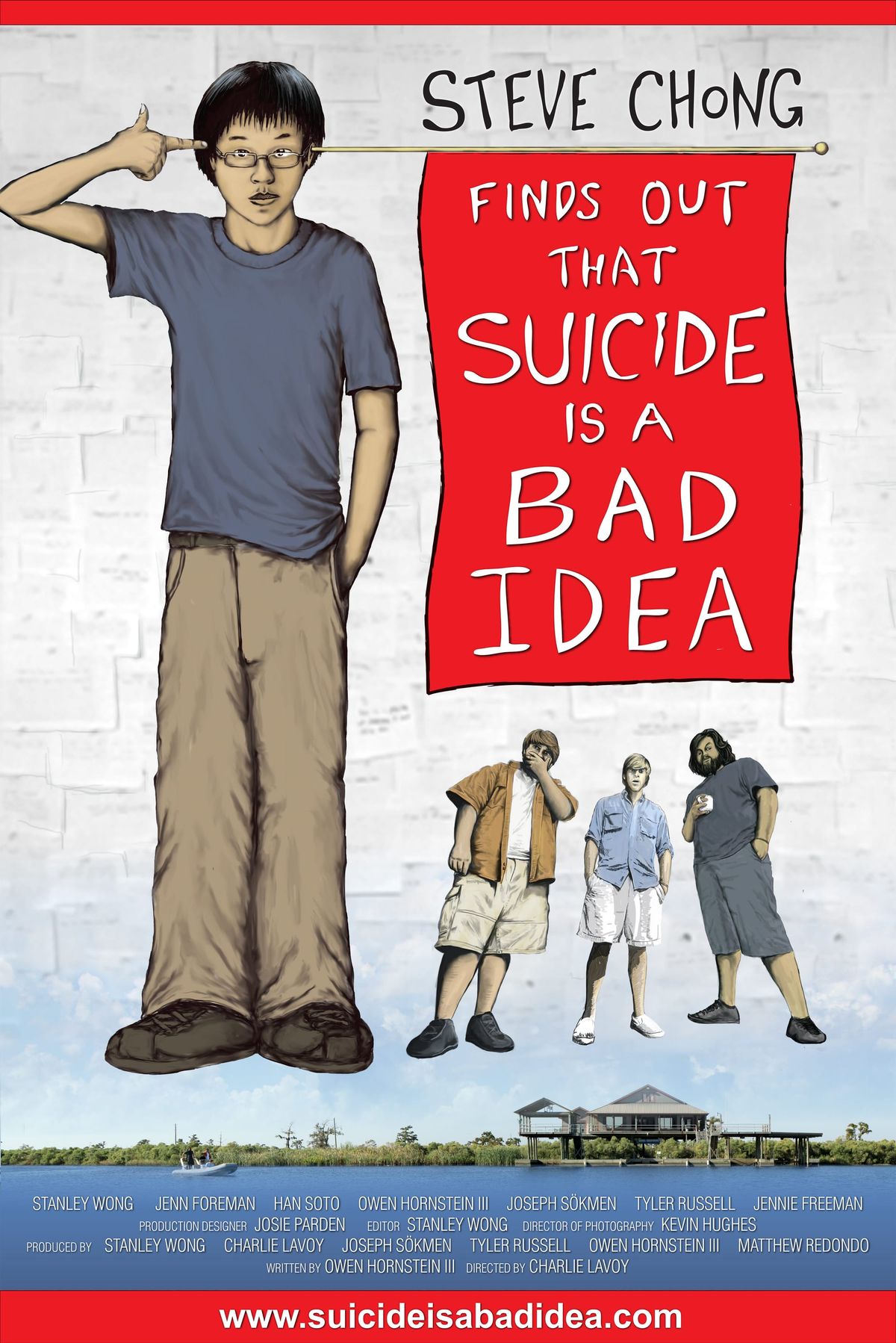
Steve Chong Find Out That Suicide Is a Bad Idea
by Bethany Lewis
Spoiler alert: Steve Chong does indeed find out that suicide is a bad idea, but how or why he comes to that conclusion is entirely unclear and this after ninety minutes of the audience wondering why the heck he’s suicidal in the first place. Steve Chong (Stanley Wong) is a graphic designer by education, a dead-end sushi chef by trade, and obsessive note card writer at heart. Steve writes note cards to remind himself of every flicker of anything negative that ever happens to him – from spilling a soda to losing his job – building up a wall of pointlessness, and then continuously (consciously or unconsciously) turning down any chance of anything good ever happening to him. On the same night he gets fired from his job and absurdly turns down multiple hopeful advances from the girl he secretly loves, Steve makes the decision to kill himself. But first, he calls up his three slightly over-weight, dark-haired, shaggy, bro’d, and bearded friends for a weekend at his sweet lake house to which he had always refused to take them. “Why have you never brought us here?” Asks one of the doppelganger bros. For no reason at all, as it turns out.
The weekend continues in a pale imitation of The Hangover as the bearded clones first convince the teetotaler Steve to take shots at totally random intervals and end the night in a game of Kings – a game which everyone knows is really boring unless you’re drunk and actually playing it. Steve shockingly draws a king and slyly makes up a rule that any person drawing a card has to reveal something about themselves that they’ve never told anyone else. Steve first admits that he’s never slept with a girl, perhaps revealing the real disappointment behind his depression. The others find this unsurprising. He then fosters conflict at the table and proceeds to “monologue” about his decision to commit suicide, ending abruptly with a declaration that he has to puke, and leaving the freak triplets at the table to share their shock and concern about Steve’s revelation. The weekend continues from there with the friends deciding how to handle the situation and how to approach Steve about his issues. The most prominent and least profound idea unsurprisingly centered around getting Steve laid – because that clearly solves most existential crises (except of course for the film version of M*A*S*H*, where that actually was the solution to an existential crisis).
Their feigned nonchalance and resultant awkwardness is perhaps the funniest and most relatable thing about the movie. Upon drunkenly realizing that just about everything in the lake house is a potential weapon, the three identical friends proceed to not only hide the kitchen knives and forks but put marshmallows on the fishing hooks and oven mitts over the claws of the taxidermy bears. And while the three friends bear a striking and initially confusing resemblance to each other, it’s ultimately John (Joe Sökmen) who stands out among them. He is understated and dryly witty, a perfect complement to the frenzied screwball energy of his counterparts. He is endearing because he reminds us of ourselves, the reasonable one caught in a madhouse of the insane people we’ve chosen to be our friends. And while his story is just as random and no more interesting that anyone else’s in the movie, his presence does stand out among his lookalike cast mates.
In the end, it seems that the state of limbo in which Steve finds himself is of his own making, constantly refusing to seize opportunity and seizing upon the subsequent disappointment instead. There is nothing keeping Steve where he is except for Steve himself – brooding over the attainment of shallow successes and wallowing in petty disappointments. But in this case the film brings up an important point. So much of our disappointment, depression, and sense of self-worth is self-made, our failure to succeed is a self-made prison. What prompted Steve to escape this self-made prison is still a mystery by the end of the film, especially since nothing significant seems to have taken place or anything of worth has changed. Perhaps the answer is that he hasn’t escaped it. Maybe nothing has changed and he’s just fooling everyone. A grim thought indeed – perhaps the darkest and most profound of this dark comedy, which is ultimately neither very dark nor particularly very funny.