Mary Horror
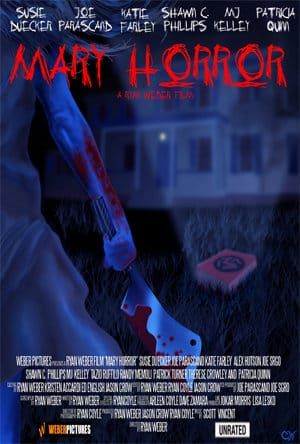
Ryan Scott Weber’s MARY HORROR (2011) isn’t just a slasher flick where some zombified chick goes mental on all who wrong her. Well, yes, it is that, but there’s more to it than the required campy synth music alongside cut shots of cleavers and body parts.
Make no mistake, this is B-movie material through and through, so if that’s your bag of tricks, MARY HORROR may be your candy land. I, admittedly, am not drawn to B-movies regularly, but if one can look past the rawness of the production, what Weber’s created here is equal parts Scream, M. Night Shymalan and classic slasher mania.
The Scream in MARY HORROR is in Weber’s examination of the exploitation of tragedies. Many of us are guilty of it – how many towns have their own ghost stories and haunted houses? Of all the aspects of his film, Weber most succeeds in shedding light on this absurd fascination we have with murder and mayhem. There’s a brief moment in the film, after the frantic opening sequence is reprised (now with plenty of explicable backstory) when the townspeople are in a celebratory frenzy post-murders, hawking t-shirts and other swag. Weber’s approach is much like the silliness with purpose used in the TV show SUPERNATURAL. It was the most entertaining part of the film.
Weber’s attempt at inviting us into the psychological motives behind his serial killer’s actions fall short of their intent. A large part of the film is dedicated to backstory, prior to guts and gore, yet MARY HORROR still comes off as forced, as a movie where we sit back and say – well, it’s a movie, I’ll let it pass. Take, for example, the moment Mary’s counselor breaks doctor/patient confidentiality without hesitation. Or the unconvincing conversation Mary has with author Michael Chadwick (Tim Manning), where she’s told of the truth behind her family’s murders. Small examples, yet representative of some of the forced scenarios depicted.
The title role of Mary Horowitz/Horror was played by Susie Duecker, who encompassed the range of her part (from teen girl to zombie chick) so well that it could be said she, herself, was possessed. In the scene mentioned above, with Chadwick, Duecker is required to bellow out in a level of agony that surely must have physically and mentally exhausted this young actor.
Duecker and the rest of the cast had to, at times, deliver lines that frankly just didn’t sit right (would a teenage girl say “since the disappearance of Kelly” when talking about her best friend?). Despite that, Duecker’s delivery seemed believable yet also fitting for the B-movie style of MARY HORROR.
The payoff for these types of movies is the slashing action, which Weber gives us in big doses throughout the second half of the film. Weber revels in B-movie glory. Mary’s victims fall down domino-style, like stalks of corn. Amid the slashing Weber gives us one more big reveal, (here’s where Shymalan’s style is instilled) which not only explains how all this madness happened to begin with but also deepens Weber’s analysis and satire of our obsession with the gruesome side of life.
MARY HORROR is not the finest hour-and-a-half of cinema but, (knowing Weber’s hoping to make a follow up to it) the film is intriguing enough to keep us wanting to see what’s next.
I can’t say I’d watch it again, but neither will I say it was a waste of my time.