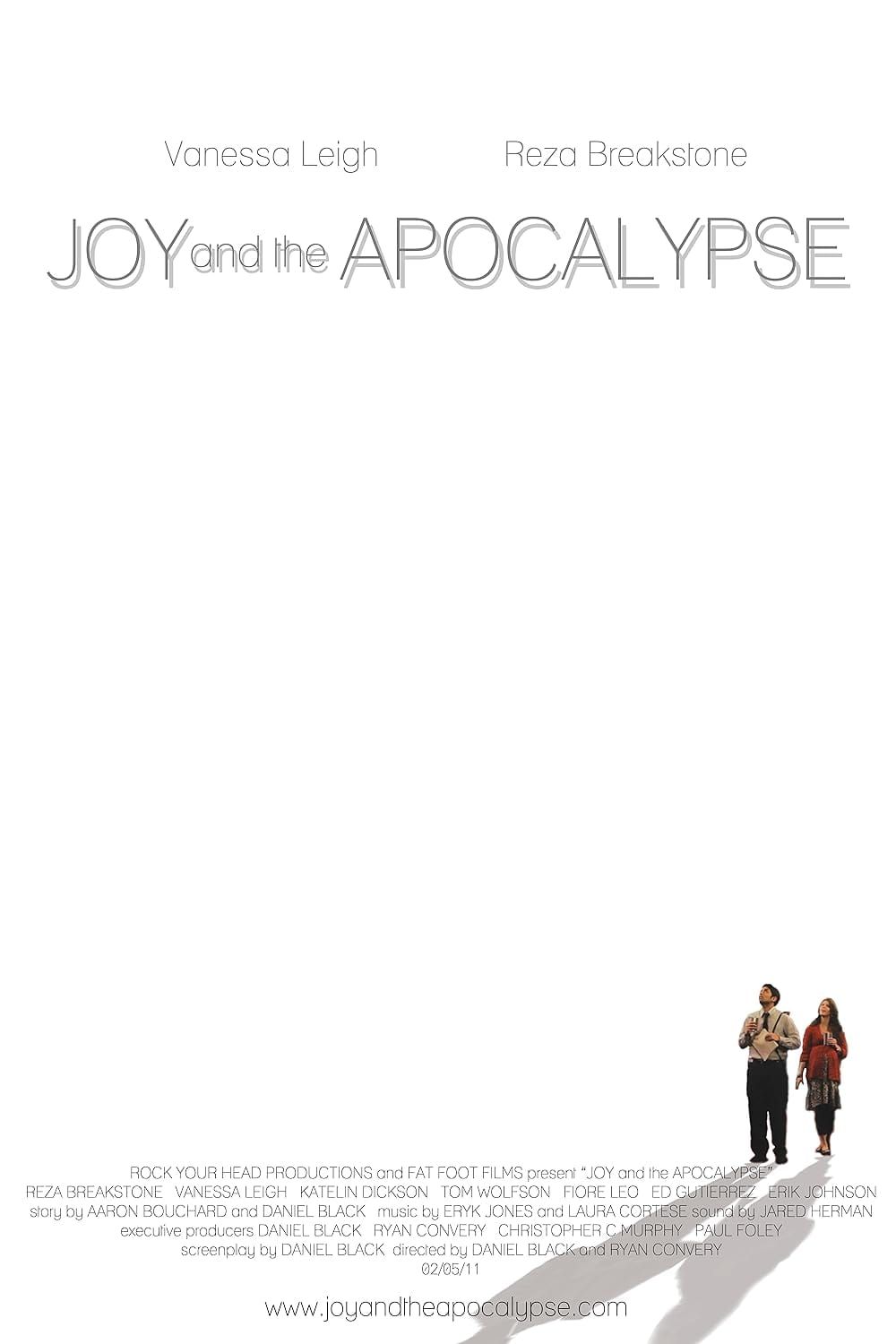
Joy and the Apocalypse
By Katherine Bennett
A film by Rock Your Head Productions and Fat Foot Films, MMXI
JOY AND THE APOCALYPSE is a romp around your brain, and then a sit-in in the places where you figure things out, gratefully providing you with an answer to the film’s questions, and the basic questions about the meaning of life.
Screenwriters Daniel Black and Aaron Bouchard lead us by the hand to observe the seemingly upbeat casual, though rushed morning of the main character, Ben. He’s on his way to meet someone, and is running 15 minutes late. When he arrives, the destination is a nondescript coffeehouse. The object of his meeting, an unpleasant, demanding and wholly unappealing woman we realize is his fiancé, Linda goes on about how the architectural plans need to be finalized for the Church that day, and she references something about an asteroid destroying Earth. Hearing that, I realized I was in for a wild ride. The story gives quick insight into the larger picture when a fellow coffee drinker comments to Linda that “she’s a big fan”. But we don’t have a clue what that means.
When, moments later, Ben runs into a very pregnant old girlfriend, Joy, outside the coffee house, and she references too, that it’s the last day of life on Earth before an asteroid destroys most inhabitants, I wholly felt beyond bad for him, ruffled about him hopefully figuring out just how crappy his life with Linda is.
Soon after, on his walk to work, he encounters Joy again, and the method to his day goes out the window. Despite time deadlines looming like no others, he opts to let life happen to him and walk with Joy awhile. When she has apparent contractions, he goes to her side. When she says she’s hungry, he agrees to go get a sandwich with her. When they end up in the park, you realize that things are again, not as they seem. Joy drops a pillow out of her dress, and a guy in a hospital robe claiming to know her and follow her orders, holds Joy at pencil point, asking Ben to answer a riddle. The riddle is: What do poor people have that rich people don’t, and that, if poor people eat it, they will die.” Eventually, Ben answers the riddle: the answer is, “Nothing.”
Chaos ensues for a while. Dialog about mental illness, people not knowing what’s real, Ben being told by the man in the hospital robe – we find out it’s her murdering brother, that he should just forget Joy.
Then, Ben shows up at his fiancé and father’s house. There, it’s supposed to be the last day on Earth. Some people are dead on the couch – victims of suicide at the hand of cyanide. Ben’s not-to-be Father-in-Law starts to talk to Ben about how It really is. He confesses that he and his daughter found someone in Ben who would just go through the motions and give his free will for determining how he wanted to live, away. Thus, his fitting name, Ben Dover (bend over). And, that Ben’s actions allowed them to hopefully design a Church that the surviving colonists can build, and in this way, they can owe God nothing.
We don’t know exactly what’s up when Ben throws his drink of cyanide on his not-to-be Father-in-Law, after commenting that his relative in a concentration camp wrote that what he noted most in the gas chamber was the smell of almonds – not the death related to the bodies he was moving, but the smell of almonds. The point of this is not fully clear, but this is the first point in the film where you realize that there is substance here. The message of the prior minutes is that life is worth living, worth self-determining. The message about the smell of almonds is, “don’t miss the forest for the trees; don’t be deceived into focusing on facts that don’t give you value.”
But value in what? We have to wait some minutes for that piece of the message to come. Soon after Ben throws the cyanide drink in his not-to-be Father in Law’s face, he finds Joy in the hallway of that building. She says she wants to go with him to the theater – presumably to watch the sunset, something they had referenced as what they did on their first date.
When we next see them at the theater, they kiss, and we then see many of the people in the story in a dressing room. The film moves fast after that, with the Director, presumably God, saying that because Ben did not act out the day as he should, he is being replaced. The Director then delivers a speech to the audience in the live theater, that feelings are the only thing meaningful in life, and that we need to disregard all circumstances that surround them.
After the play concludes, the actors that played Ben and Joy meet outside the theater and decide to go on a walk. They casually decide, neither concerned about where they are going, agreeable instead to just feel.
JOY AND THE APOCALYPSE is a film that sneaks up behind you and then delivers a very simple message, leaving you glad for yourself and the characters of the film, that really all we have to do, is show up and feel.