
Determinism
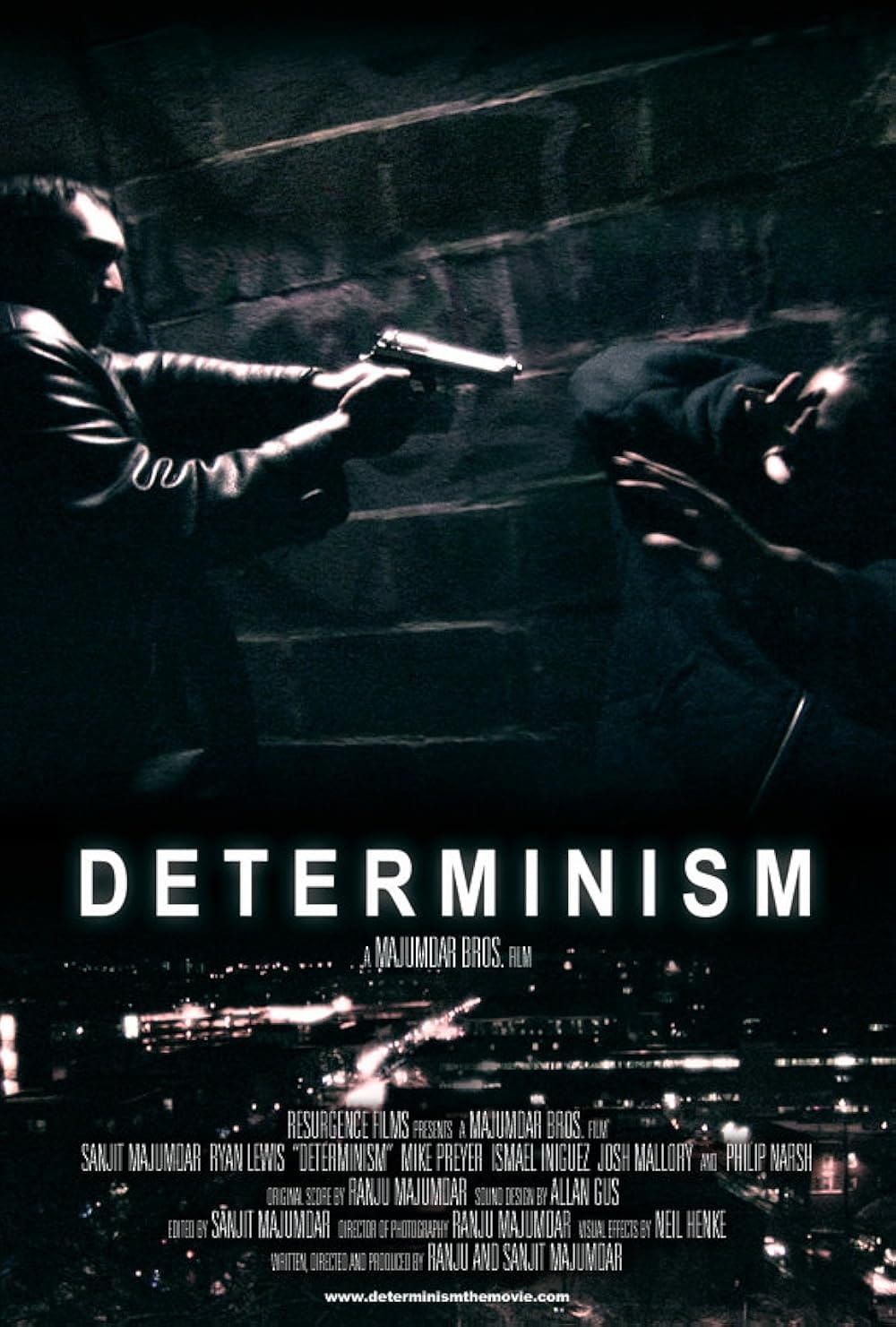
Sanjit and Ranju Majumdar’s DETERMINISM tells the story of a college student, Alec (Sanjit Majumdar). He is bored and malcontent, so obviously he turns to a life of crime. He enlists the help of his friend, Tristan (Ryan Lewis), a former cocaine addict, to rob a drug-dealer. This is done so Alec will have the money to go somewhere else and start a new life.
This is a student film and wouldn’t be mistaken for anything else. The primary setting is a college campus, and the cast is clearly made up of college-age non-actors. Though well-shot and effectively paced, the story gets hopelessly muddled by incongruous dialogue, unconvincing character motives and far too much plot for the film to carry.
DETERMINISM gets off to an unfortunate false start which it is never fully able to recover from. It opens with Alec filming himself giving a monologue about the disenchantment he feels. The problem is that in order for Alec’s downward spiral to be believable, we need to see why he has grown so world-weary. Other than a general sense of boredom and the fact that people keep mistaking him for Arab (a running joke which grows tiresome), Alec has no real reason for deciding to go from student to criminal.
On top of that the film meanders through the lives of some of the side characters. We are introduced to various drug and gun dealers who really don’t have all that much to do with Alec’s story. By the end of the film, there were so many double crosses and chance encounters and coincidences and a particularly perplexing mystery video that I found myself bewildered. I wasn’t sure why the characters were doing what they were doing or who they were really doing it for.
The movie uses criminality as nothing more than a plot convenience. It offers nothing about the nature of crime and no insight into those who perpetrate it. The only reason Alec gets involved is because he is bored and stupid (and by the way, I really hope it was the writers’ intention for the viewer to read all of the characters as exceedingly dumb and unlikeable). The notion of crime presented here seems to come from movies and TV, not a genuine understanding of the subject.
There is an old adage about writing that says, “Write what you know.” I think that people often take this to mean that you should only write about what you have personally experienced or studied. Obviously, if this were the case there would be no science fiction or fantasy. I take the saying to mean something that has to do more with understanding your subject and understanding yourself. The bottom-line is that if you want to write a crime film, but all you know, and more importantly understand, about crime comes from movies then you may want to reassess your story as well as your ability to tell it.