Crestfallen
by Bethany Lewis
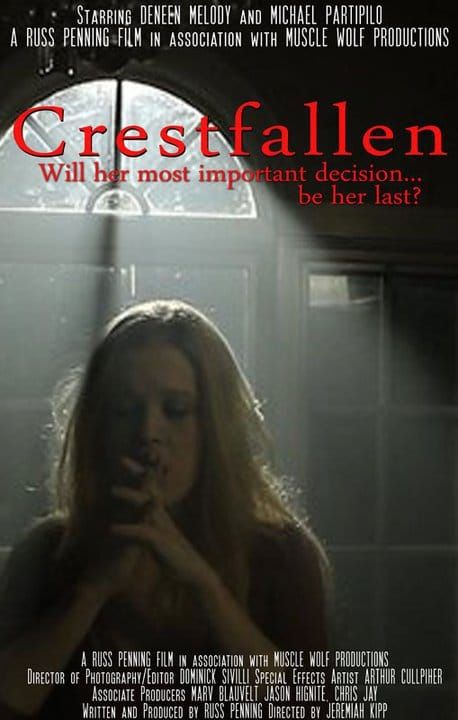
The beauty of short films is that you can do and try an awful lot in a short amount of time without having to worry about the time and money it takes to make a feature film. It is the perfect format for experimentation of both content and style, and CRESTFALLEN uses this format to its full advantage in both areas. CRESTFALLEN is the disjointed story of a woman who attempts suicide, the reasons for which are presented in a collection of non-linear and jarring flashbacks. The film is silent aside from the excellent and haunting score by Harry Manfredini (best known for his work on FRIDAY THE 13TH), which beautifully compliments and completes the emotional foundation expressed through the acting, cinematography, and editing.
Director Jeremiah Kipp takes what in other hands might be a tedious and trite story and presents it in short, expressive bursts of striking imagery that explores the human experience of pain, weakness, and strength. The film has the vague impression of being someone’s terrible, fevered nightmare – a collection of related, stream of consciousness images and a fatalistic march toward an act of self-harm that the waking part of your mind can’t stop. The dreamlike quality of the film reminds one of Maya Derren’s MESHES OF THE AFTERNOON in certain of its editing and imagery – specifically that of Lo (Deneen Melody) contemplating the knife with which she will ultimately cut herself. In fact, while Manfredini’s musical score is almost entirely dissimilar from Teiji Ito’s score that was later added to MESHES OF THE AFTERNOON, there are certain musical cues – specifically the drum beats that denote the various flashbacks – that are reminiscent of that idiosyncratic composition.
Anyone familiar with some of Kipp’s other short films (DROOL, 2011 and CONTACT, 2009) will no doubt detect a running theme of style and content. The director favors silent film, jarring cuts, disjointed storytelling, black and white coloring (or in the case of CRESTFALLEN, muted color schemes), and disturbing or disconcerting imagery. They are all incredibly striking, technically proficient, and thought provoking films – refreshingly open to interpretation and debate given their abstract and silent quality. And here is where open interpretation and debate comes in, because the content of these films usually involves a woman in distress, whether as a result of her own actions or by the hand of someone else. A recurring image near the end of these films is the woman, distressed, naked, and curled up in the fetal position. While these films are clearly presenting female victimization and harm as a disturbing concept and by no means advocating violence against women, it is slightly disconcerting that these women are presented only as helpless victims, powerless to take action. In fact, their victimization comes as a result of taking action – whether by exerting the right to express sexual desire and subsequently being forced sexually (DROOL), by taking part in a sexual drug experience and paying of it with a bad trip (CONTACT), or by challenging a sexual betrayal by taking part in some sexual betrayal of her own and subsequently having her child taken from her (CRESTFALLEN). These women are punished not just for taking action, but for owning and expressing their sexuality and individual power. While these are things that happen every day to women who live in a controlling patriarchal world, it is a troubling statement about the nature of woman that these women are ultimately left helpless, naked, and childlike on the floor, never to challenge those experiences or to grow from and beyond them. There is a glimmer of hope in this respect at the end of CRESTFALLEN. While Lo may be naked and fetal in the bathtub, there are at least two shots beyond this that speak to her strength and determination – a will to live and fight beyond her victimization and betrayal. And that’s not just a good ending – it’s a good start.