Between Us
by Bethany Lewis
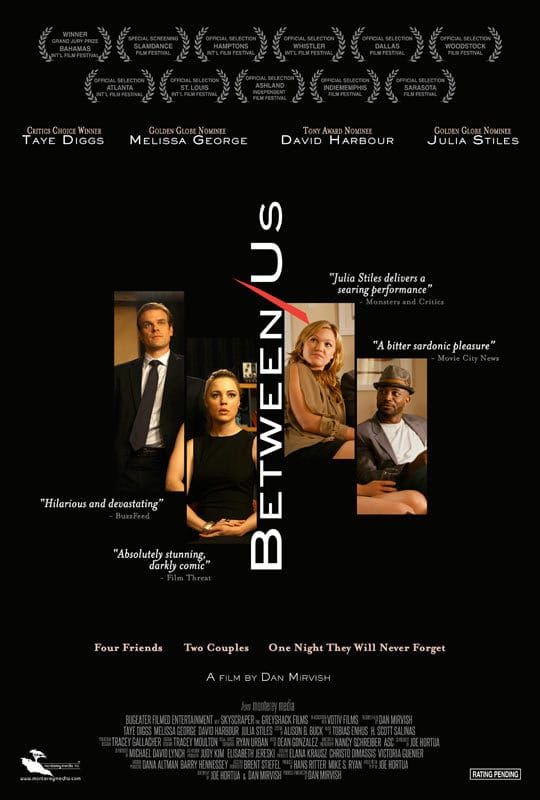
Growing apart from people we were once close to is a fact of life. Whether the shift is slow and steady or sudden and violent, we all have people we once called friends or lovers who are now distant acquaintances. BETWEEN US, written and directed by Dan Mirvish, explores the friendship of two married couples and not just their coming together and growing apart, but the characters’ individual journeys and how their relationship changes within themselves, the world, their friendships, and marriages. It is an ambitious project that comes far from any kind of resolution, but finding resolution is not the point. It is an intense, intimate, and thought-provoking study of a number of life’s facets that have no solution except to be lived through.
The film begins with what seems like a pleasant and joyous reunion between two couples – Grace (Julia Stiles) and Carlo (Taye Diggs) and Sharyl (Melissa George) and Joel (David Harbour) – who went to art school together. Not long into this reunion, however, we start to notice little ticks and flashes of awkwardness, offence, disappointment, and resentment. Sharyl and Joel’s playful bickering quickly devolves into vicious, drunken arguments, while Grace and Carlo are awkwardly caught along the sidelines. As a result of this experience, Grace and Carlo decide never to see Joel and Sharyl again. Two years later, the pair show up on Grace and Carlo’s doorstep to make amends only to encounter the couple are now having problems of their own.
In the end, the inner turmoil that everyone turns on each other is the result of dashed expectations, broken dreams, and changing priorities. Joel is a successful commercial photographer, but longs for the serious artist’s life that Carlo leads. Carlo longs for the ability to make money without compromising his artistic ideals. While this much is clear, the women’s unhappiness seems mostly to stem from their husband’s unhappiness. Sharyl seems to have no real ambitions beyond house-wifery, and while Grace has a plan to go to school for social work, the desire seems half-hearted and does not factor into her complaints about her situation. The focus here is on the men and their work, while the women are left to talk about their husbands and children. While the dynamic works well enough for what the film does, some further thought for the women and the standard gender roles might have elevated an interesting film into a compelling – even breath-taking – film.
The cast is well matched and the film well-acted in all respects, but the standout has to be David Harbour as Joel. He has a dry humor that shines through and perfectly complements both the darkly comedic and the intensely dramatic. He is by far the most sincere and genuine of the ensemble, showcasing a character with a solid foundation and a clear personality, a fully formed and complex person. His expressions are wonderful to read.
The subject matter, the cast, the style, and intensity of the film all bring to mind the films of Tom Noonan, particularly THE WIFE (1995). Indeed, the films of Noonan and BETWEEN US are similarly described as “darkly comedic” and feature the pairing off of characters, revelations of unhappiness, degenerating civility, and a focused exploration of character and relationships. And just like Noonan, Mirvish keeps this dialogue heavy film constantly engaging with non-stop intensity. And it makes us think about our own lives and relationships – friends who lost touch, goals unachieved, dreams compromised, relationships turned sour – and what we’re willing to sacrifice to get what we want.